Why do we measure espresso by weight and no longer by the traditional 25 ml in the cup? That is the question I hear over and over.
With today’s post I want to tackle a subject that is very current, much discussed, highly controversial and thoroughly confusing, precisely in order to make it clear what brew ratio is in coffee, along with everything connected to it. The modern approach to coffee runs through here too.
Taking the volume of my espresso in the cup into account hides a lot of difficulties. Think of a 100% arabica espresso against an espresso with 50% robusta: the first will have a thin crema, the second a very thick one. Following the 25 ml rule, the first will have a greater quantity of liquid in the cup than the second at the moment we stop the shot. And if instead of putting in 14 g of ground coffee we put in 15 or 16 g, what would happen? We will find out further on.
Before going on, I want to make it absolutely clear that the international community has by now turned towards this kind of calculation to determine the quality of an extraction — while remaining firm on the fact that a calculation certainly does not replace tasting and your own palate. It is the taster’s palate that has the job of establishing whether the extracted drink is to their liking or not. Using this technique does nothing more than give real, non-subjective numbers about what happened during the extraction. So my advice is always to use the system I am about to describe as a “double check”, alongside tasting and not in place of it.
Let us look for a moment at a few terms that will help us understand what follows:
Brew ratio = the ratio of the brew: in essence, how much coffee to use in relation to the quantity of water that will brew it.
Strength = the density (concentration) of the drink, usually expressed as %TDS*.
Extraction = how much I managed, through brewing, to extract from the coffee beans used for that drink. It is very important for determining whether I have under- or over-extracted the coffee. In filter coffee the percentage is between 18 and 22%, in espresso it is 18–21%, so roughly one fifth of the weight of the coffee bean should end up transferred into the final drink for a “balanced” extraction.
*(%TDS) = Total Dissolved Solids: the quantity of substances present in my espresso relative to the water that makes it up.
That said, let us look at how to use this system to control our extractions.
Coffee is a foodstuff which, in order to be enjoyed the way we all want to enjoy it, needs to be transformed from a solid (the bean) into a liquid (the drink).
I have already written here about how complex it is to transfer the substances contained in ground coffee into the cup, and about the importance of grinding.
Precisely because the “solvent” we have to use is water. 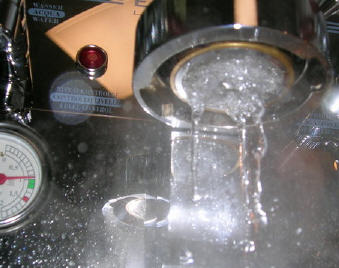
The water used to dissolve the substances and carry them away from the coffee cells is often the keystone of the extraction itself, because there is a close relationship between the quantity of water used for the job and the quantity of substances extracted. Obviously there are a great many parameters to consider — hardness, pH, which mineral salts it contains, alkalinity and so on — and lastly the temperature at which it extracts those substances: higher temperature means more extraction, higher temperature means greater efficiency, and vice versa.
So brew ratio is an important component in determining how much the water has been able to take out of the coffee, but not the only one. Everything depends on the type of water used and also on the type of coffee: roast, density, substances contained, days from roasting, and so on. 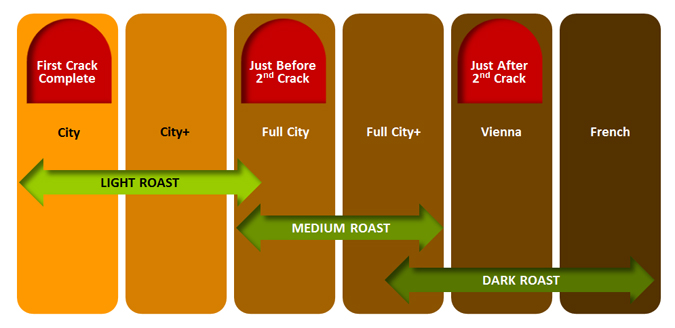
Unlike filter brewing, where the operator knows how much water is being used as a solvent, with espresso there is no certain rule — we are not the ones putting the water in — but the amount of water that has passed through the coffee grounds can be worked back from a few secondary parameters. So it turns out to be a little more complex.
For espresso the formula generally used is as follows:
Weight of the dose of grounds (grams) / weight of the drink in the cup (grams). This gives a value which, for a correct extraction, should fall between 0.4 and 0.6. Moving towards 0.4 or below means a long drink has been made; moving towards 0.6 or beyond means a ristretto has been made. This does not necessarily mean an over- or under-extracted drink has been created, but that the coffee-to-water relationship within it is different.
We can hazard over-extraction in the case of the long shot and vice versa, but that is not entirely correct: it depends on the grind and on the contact time between water and coffee.
The table below may make it clearer:
15 g (dose) / 30 g (standard drink) = 0.5 (50%)
15 g (dose) / 40 g (long drink) = 0.375 (37.5%)
15 g (dose) / 20 g (ristretto) = 0.75 (75%)
The question, however, remains the same: how much water did we use?
Saying “double” the coffee in the “standard” preparation would not be strictly correct. Let us see why.
First of all because the ground coffee retains a portion of the water that never ends up in the cup but stays “captured” by the coffee, which as we all see remains wet once we knock the spent “cake” into the knock box. So here too things get a little more complicated: what capacity does the ground coffee have to absorb water and hold on to it? It is usually calculated that on average 1.2 g of water remain absorbed in the coffee for every 1 g of coffee. For example: 15 g of grounds in the basket retains around 18 g of water. So the water that touched the coffee puck would come to 30 g (weight of the “standard” drink) + 18 g (absorbed water) = 48 g. That is therefore the water(*) that met the coffee in the espresso method.
(*These calculations do not take into account the myriad of ways coffee can differ in relation to water depending on how it is roasted, the botanical species, the variety, the density, the origin, the harvest date and so on. It is and remains an INDICATIVE value.)
Going back for a moment to the beginning: if I use 14 g of grounds (double basket) or 16 g of grounds (double basket) and I extract 25 ml — the same goes for 6.5 g or 7.5 g in a single — do you think I should extract the same 25 ml? If I do, will I get the same results in the cup? I would say absolutely not. If I use 14 g my drink will be more diluted* than using 16 g: 14 g will give me a long shot with a value of 0.35, and 16 g will give me a “less long” one with a value of 0.4. The difference looks like a few tenths, but in the cup it corresponds to 3 g more liquid, which is generally the tail end of the extraction, in order to reach the same value of 0.4.
So the barista should try to stop the shot at roughly double the weight of the grounds put into the basket.
* A standard value, considering that a 25 ml espresso might weigh 20–22 g, even though we have already said that differences between weight and volume are often down to the volume of crema on the surface.
Let us tackle another equally important point:
the concentration of the drink in TDS, using a refractometer.
How can we determine how concentrated the drink is? A refractometer can become essential, because it is an instrument that measures — through the refraction of light in relation to the drink itself — the percentage of dissolved substances in the sample analysed. For espresso the correct value lies between 8 and 12%, while for filter preparations it lies between 1.2 and 1.45% (SCAE Gold Cup Research standard parameters). In essence, the drink should have a concentration of this kind. 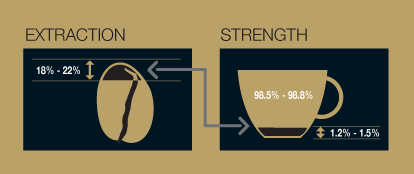
By putting all the parameters mentioned above into relation with each other, we can obtain the extraction percentage of the coffee served — as I said, correct parameters are between 18 and 21% for espresso and between 18 and 22% for the filter method. The following table, the Espresso Brew Chart that I created, may be useful to you.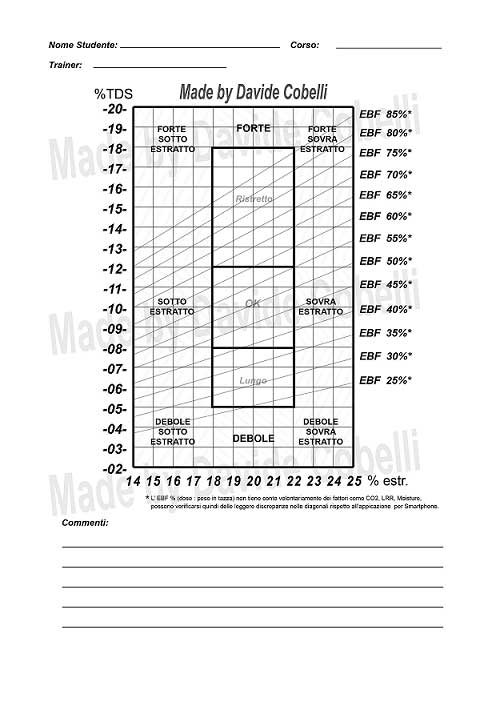
So:
quantity of coffee used, weight of the drink, ratio of the coffee used to the water used, TDS.
For this complex calculation there are apps you can download for Android and Apple, for both smartphone and PC, here.
At the end of all this I would say the subject is extremely complex, but at the same time fascinating, in the search for approaches that are less approximate and more scientific — bearing in mind, as I have already stressed, that the last word always belongs to the consumer’s palate, above all because there are no absolute parameters in coffee: it is a drink far too complex to have them.
In essence: not a replacement, but an addition to what we are already doing.
By Davide Cobelli